journal

things to remember

Coffee. A daily essential, much like writing.

In my recent article about journalling, I mentioned that I often dedicate several pages - usually the first or last two or three - of my journal to “things to remember”.

By that I mean, I write down phrases, affirmations or reminders that ground me, things I find useful to hear often depending on what is currently going on. If I read something in an article or book, or hear something someone says in a podcast, that particularly speaks to me, that might be helpful for me to bear in mind at the present time, I will write it there. I also sometimes write down insights that occur to me in daily meditation.

I highly recommend this practice of writing down things you find comforting and grounding that you can look at and remind yourself of, especially if you’re a bit like me and find your anxiety running away with you at times. It can be really handy to look at it in your over-thinking moments.

As I’m just coming to the final few pages of my current notebook, I thought I might share some of the things I felt moved to remind myself of or ground myself in the truth of this last little while, in the hope it might be useful for you too. Perhaps I’ll make sharing these a regular thing.

Things to remember

  • Karma never loses an address.

  • When victory comes at too heavy a price, there’s honour in choosing defeat.

  • The seeds we nourish and cultivate within us are the seeds that grow.

  • Every storm eventually runs out of rain.

  • No matter what you do, someone is bound to end up disappointed…so do what you want.

  • There is no ahead or behind, everyone is walking a different path to the same place.

  • You can have what you need, even when others need you.

  • Confidence is quiet, insecurity is loud.

  • How other people treat you is a measure of who they are, not a measure of your worthiness.

  • Live with reverence for what truly matters.

  • Be radically responsible for yourself.

Daphne (my favourite winter flower) on my desk at work as the sun started setting.

  • No one has any power over you, only the power you’ve given them.

  • Other people’s opinions are always one of two things: completely irrelevant or feedback you can choose to take or leave.

  • Resilience is an asset.

  • Live, and write, with audacity.

  • The work is your domain, you are not in control of the rest.

  • Finish what you start.

  • Ripe fruit falls quickly.

  • Discomfort is the price of admission to a meaningful life.

  • Being hard on yourself is never the route to more joy.

  • You are going to be OK, regardless of the decisions and behaviour of others. You have survived everything so far.

  • You are at your most powerful when you trust yourself.

  • You are more than your thoughts. You are more than your body. You are more than the place where you live, your job, your bank account, your current health, your trauma, your highlight reel and accomplishments, your lowest moment and your worst day. You are enough. You always have been.

And finally….

“You will never be able to experience everything. So, please, do poetic justice to your soul and simply experience yourself.” - Albert Camus

how to start journalling (and make it a habit)

I have been journaling for 1,243 mornings straight… (since 20 December 2019)

I get asked about journalling quite a lot. So I thought it was time I wrote a blog post about it - so if this is your bag, strap yourself in, get a cup of tea and enjoy one of my famous long reads!

my journalling habit

I started journalling (or “keeping a diary” as I called it) regularly in 1991 several months before my tenth birthday, and I continue to this day - in fact, right now I am a more regular and prolific journal-keeper than I ever have been.

I started writing Morning Pages daily at the end of 2019, a few months in to my PhD studies. Morning Pages are a practice that involves filling three pages (no more, no less) with whatever it is you’re thinking, stream-of-consciousness style, first thing every day. You should feel free to write whatever you want because in theory no one is ever going to read it, not even you. It’s simply a way of emptying your mind of the dross so that if you want to do some creative work, your mind won’t be preoccupied with the usual things it latches on to, preventing you from doing some deep thinking and creating.

I wasn’t new to the concept - I had done Morning Pages for a few months here and there over the years, but this time I really stuck with it. I’m not sure what it was about this time. Perhaps it was everything that happened at the start of 2020 and I suddenly had a desperate urge to capture and make sense of everything that was happening.

The notebooks I filled between April 2019 and August 2021.

Over three years later, they are still a daily habit! And I have no plans to ever stop. Even Tom is now doing Morning Pages, as he's seen the benefits it has had for my creativity and productivity, and he wanted in!

A journalling prompt for you, perhaps?

I call my morning journalling ritual “my pages” but I don’t think they’re Morning Pages in the strictest sense - they are not truly stream of consciousness (though sometimes they are) nor are they a considered, thoughtful setting down of what has happened in the previous 24 hours. I’d say my daily “pages” are somewhere in-between the two. That works for me.

Indeed, as Julia Cameron says herself, there’s no wrong way to do Morning Pages. Doing them is what’s important.

Alternatively, you might prefer reflective journalling at the end of each day. Helen Garner, possibly Australia’s most famous diarist, once said in an interview that, as she lives alone, she liked the evening ritual of just setting down a few thoughts on “how things went today”. I occasionally write in my journal in the evening too, I especially like to do a gratitude practice (see further).

Why do it?

Why do anything? Because you want to.

Because it brings you joy, clarity, calm, purpose.

Because it helps.

I do it for the same reasons I write in general - to figure out what I really think and feel, to work out what’s really going on. To remember things I don’t want to forget.

A momentous day indeed!

Posterity is a great reason to keep a journal. I have not had the heart or nerve to read any of my journals prior to 2006 (there aren’t many but I know they’re most likely incredibly embarrassing!) but I quite enjoy looking back through my more recent notebooks, even though Julia Cameron warns you not to read back through your Morning Pages in case it impedes you and wakes up the inner critic. I’ve not found that to be the case, yet.

I’ve come to realise that as great as it is to record the momentous occasions in life in writing (see picture!), it’s the random thoughts and the details of everyday life, as I was living it then, that I most enjoy having access to, thanks to regular journal keeping. Suddenly, the details are so clear. It’s like being back there.

I have at least five notebooks each for the last three years alone, but back in London it would usually take me a year to fill just one. Life was so hectic then. I wrote as much as I could but I wish I had written more. I was so convinced I would remember everything.

So now, I write every day. The most basic, mundane stuff. Because one day, it won’t be.

Ideas for getting started

Morning writing

As detailed above, I think making the ritual of journaling first thing in the morning, with your cup of tea or coffee, is a great way to start making it a habit. You will start to really look forward to it. It can be Morning Pages in the truest sense, just stream of consciousness until you’ve filled three pages, or more considered ordering of your thoughts. It’s up to you!

Gratitude journalling

This is also a lovely practice to get in the habit of, particularly if you want to change your mindset to a more positive one. Recognising your life’s many blessings, however small, can really help give you perspective. You don’t have to fill three pages if you don’t want to (though it’s easier than it sounds). You could just write five things that you noticed or that happened today (or yesterday, if you’re writing first thing in the morning) that you’re grateful for. I try to do this as an evening practice as well as my Morning Pages.

Travel journalling

Travel is a wonderful excuse to buy a lovely notebook (maybe in the place you’re visiting?) and start setting down what you get up to each day, the people you meet, the sights you see, the thoughts you have being away from home and everything familiar.

Prior to my current daily pages habit, the most prolific I had ever been with journalling was my solo trip around North America and my first few months of living in London in 2007. Every day, every hour sometimes, held new and wondrous things that I knew I wanted to capture and remember forever. There are only a few times in your life, I think, when you know you’re in some golden days while they’re actually happening, and that period of time was mine.

Dream journalling

Personally I don’t do this unless there was a dream that was particularly vivid and it’s all I can think about when I pick up the pen to do my Morning Pages. But many people do and find it useful, if not entertaining. It can be a great way to observe your subconscious at work.

Abundance mindset / affirmations

I really like doing this too, and I’d highly recommend checking out Bernardine Evaristo’s interview (and her wonderful memoir Manifesto) about positive intention setting.

Writing down the things you want to happen has some kind of magical power I’ve never quite been able to put my finger on. Recently, I was looking through a 2013 journal and found I had written down that I wanted to start putting a PhD proposal together. I was still living in the UK then so I’m not sure which university I had my sights set on, but the dream I’d had since I was a teenager was still with me. It took another six years to put a proposal together and get accepted into a PhD, but here I am, in my final year. Time is not a butler, as Austin Kleon put it. Things will happen on their own timetable. The trick is to stay open and never ignore a dream that won’t go away.

Things to remember

I’ve often dedicated several pages - usually the first or last handful of the current journal - to “things to remember”, reminders that ground me, things I find useful to hear often depending on what is currently going on in my life. If I read something in an article or book, or hear something someone says in a podcast, that particularly speaks to me, that might be helpful for me to bear in mind at the present time, I write it there.

Things like:

  • “I am always taken care of, regardless of what I believe I do or don’t need.”

  • “Other people’s karma is none of my business.”

  • “You can’t control how people behave or treat you, you are only in control of how you let it affect you.”

That kind of thing. Perhaps it’s affirmations, but it’s all useful things that I find comforting and grounding. I highly recommend this if you’re a bit like me and find your anxiety running away with you at times. It can be really handy to look at it in your over-thinking moments.

Art journalling

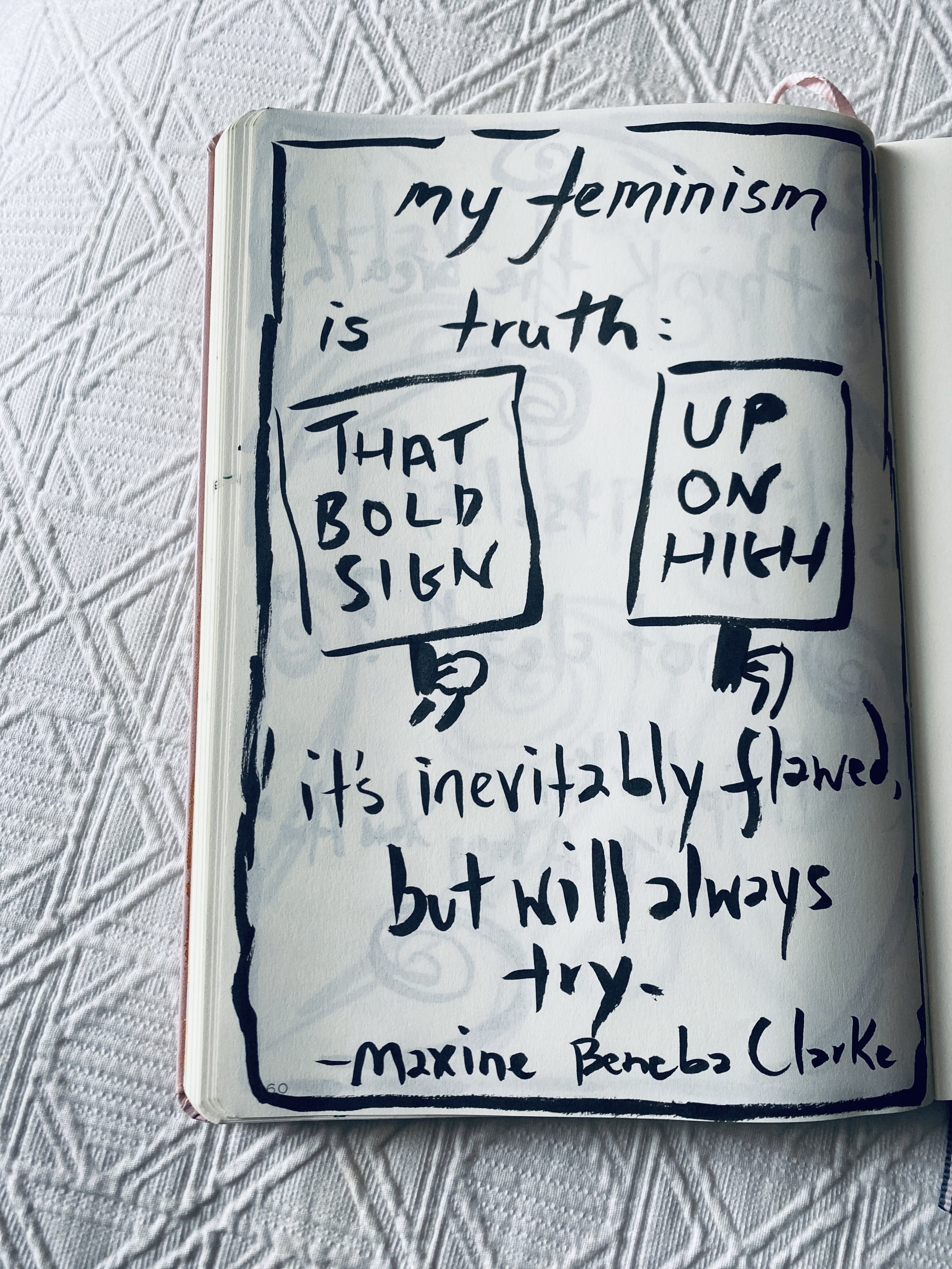
Sometimes, with my brush pen, I copy out quotes and lines of poems that speak to me, and embellish them with ink paintings…well, I do my best.

Or I just draw lines and patterns with the brush pen, and add phrases or single words. It’s great fun.

Lines from the poem “I Imagine Myself In Time” by Jane Hirshfield, one of my favourite poets.

Here’s my thoughts on a couple of other frequently asked journalling-related questions:

do i have to do it every day?

No, not at all. But in order to make it a habit, if that’s what you want, you’re probably going to have to get into some kind of regular routine with it that works for you.

But don’t worry, it’s normal to go through periods of not really feeling it. To be honest, I’m going through a period of that myself. In 2020, with every day being so charged with uncertainty and life changing so rapidly in such a short space of time, I kind of looked forward to writing my pages each morning. There was always something to write about!

Recently, I’ve noticed a little inertia creeping in. And that’s OK. I don’t want to give up the daily habit, seeing as I’ve stuck with it for so long, so I’m just making my peace with currently writing utter nonsense, repetitive garbled words that can barely be called prose. It’s fine, I’m not Anaïs Nin. These are not going to be published. These will just be the pages I flick past, or rip out, if I ever read it in future.

what if someone finds it and reads it?!

This is one of the things I hear most frequently and, I must admit, it has worried me in the past too.

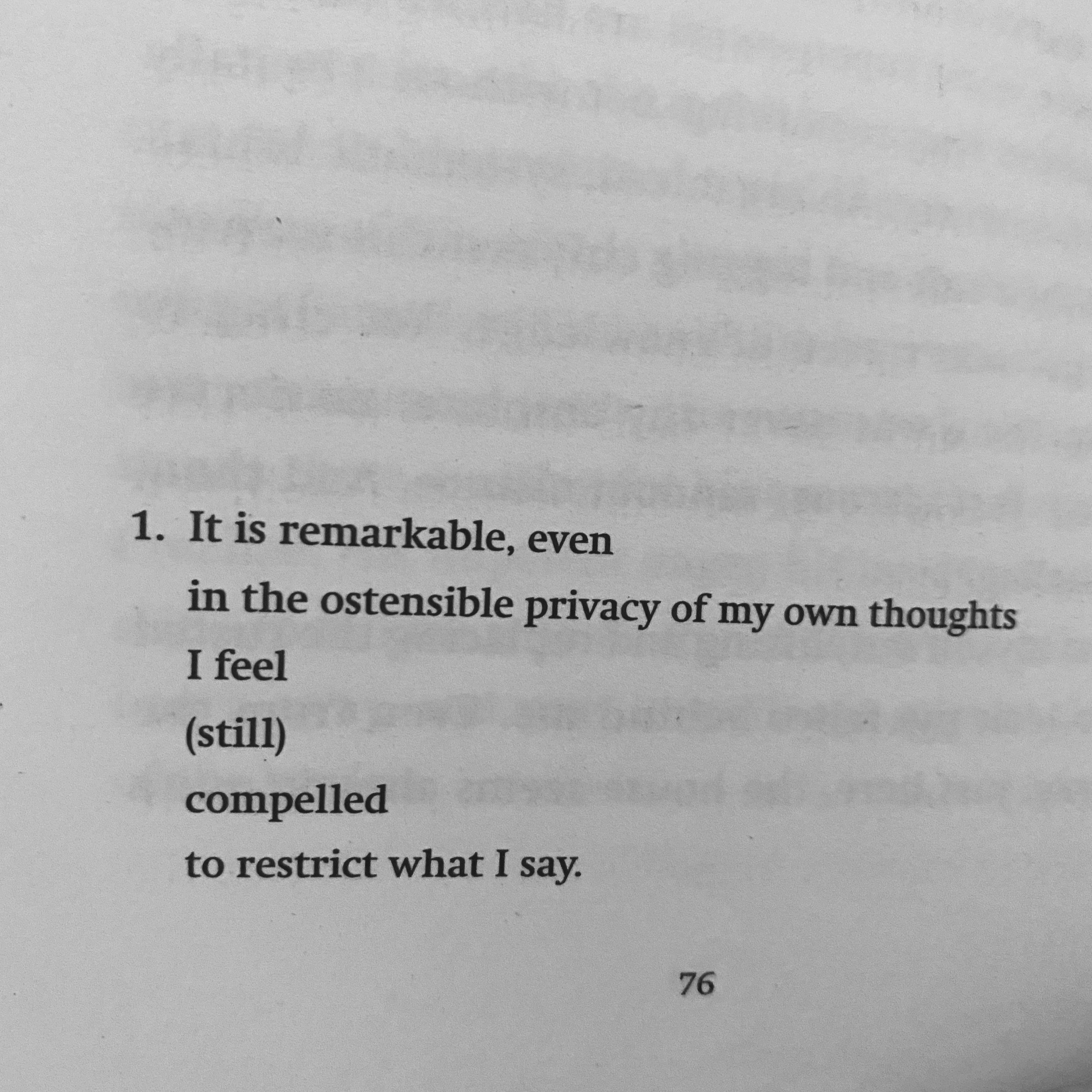
A quote from the brilliant novel Assembly by Natasha Brown. A must read.

When I was younger, I had my journal found and read by people who I never intended to read it, who then used what was in it against me. It was admittedly a very long time ago now but I still struggle to find the words for how scarring and traumatic it was. It made me feel like nowhere was safe for my private thoughts or, more accurately, I wasn’t allowed to have them. Everything about me, even my thoughts, had to be curated. No wonder I spent so much of my early adult life doing things that felt so incongruent with who I truly was - trauma and shame kept me from using my voice’s most natural outlet. Without it, I had no idea what I truly felt, thought or wanted. I was lost, and completely at the mercy of others.

Thankfully that’s no longer the case and those lost years are just part of my origin story now. But it’s taken me a long time to own my words, to wield their power well, and to reject the idea that I am solely responsible for their impact, particularly if they’re read by an unintended audience. I’m getting there but it still takes a lot for me to write truly uncensored. Though I can’t deny, with everything that’s happened over the last year, it’s such a release when I do!

If you’ve had a similar violation of your privacy and trust, or have reason to believe such a thing might happen, please know you are not alone. I can only advise you to do whatever it takes so that you can convince yourself that your journal is your safe space. Know that you are entitled to privacy and respect, no matter who you live with or how old you are. Keep your journal in a safe place, out of sight or, if necessary, under lock and key! Alternatively, write your pages each morning on a cheap notepad, then burn or destroy them afterwards, don’t keep them. What matters most is that you have a way to express yourself.

I have small children. time for myself in the mornings? What’s that?!

The fact that my morning routine is something I am able to prioritise and do without interruption every day is not something I take for granted - it is one of the great joys of my life and helps me feel anchored and get in a good mindset for the day. I can’t speak to how to best do that if you have small children but my old blogging friend Dr Jemma has a great episode on her podcast about how to create a nourishing morning routine with kids. I think this is her updated version, as she’s recently become a mum of 4! In fact, if you’re a busy and ambitious parent, you need to subscribe to her podcast!

My friend Katie Parker, who also specialises in supporting mothers of young children with their business goals and life balance, has some wonderful resources on her social media and has spoken often about the benefits of journalling.

published journals I love and would recommend

  • The Diary of A Young Girl by Anne Frank (the one that started it all for me, aged 10!)

  • I devoured the diaries of Anaïs Nin as a teenager but have not read them for many years now. They are a classic of the genre, as she was such a pioneer in terms of writing that walked the tightrope between public and private. Not for the faint-hearted. This LitHub article is a great introduction!

  • If you’re a fan of New Zealand writer Katherine Mansfield, her journal is worth reading.

  • Nigel Slater’s The Kitchen Diaries trilogy are all wonderful - the first is probably my favourite. I do long write something similar one day.

  • Stephanie’s Journal by Stephanie Alexander (out of print) - again, a lovely blend of food and life, documenting the year 1997 which turned out to be quite momentous for one of Australia’s most loved and respected chefs and food writers. Worth looking out for secondhand or in an op shop!

  • Helen Garner’s recently published volumes of diaries are fascinating reading - my favourite was the final one, How to End a Story. She is so crisp and devastating in her observations. I don’t think I will ever have her brevity!

  • Beverley Farmer’s A Body of Water - perhaps not strictly a journal exclusively, but an interesting mash-mash of journal entries and short stories alongside essays on the writing process. I loved it!

  • Sylvia Plath’s journals are a bit of a creative touchstone for me - I think they’re essential reading for anyone interested in her life and work.

  • A Notable Woman by Jean Lucey Pratt - a remarkable volume that spans almost the entirety of Pratt’s life, from 1925 when she was a teenager to her death in 1986. Writing that is surprisingly intimate, frank and fresh.

  • The diaries of Nella Last are also fascinating reading if you’re interested in life during World War Two - Nella was “Housewife, 49” who contributed diaries to the Mass Observation Project.

  • Modern Nature by Derek Jarman - this is a beautiful and utterly compelling journal where Derek, living with the trauma and uncertainty of being HIV positive in the late 1980s, documents the creation of a garden that’s as visionary, wondrous and original as his art. Highly recommended.

  • My Mad Fat Diary and My Madder, Fatter Diary by Rae Earl - full of hilarity and 1980s nostalgia, but also a deeply courageous documentation of what it was like to have a breakdown as a teenager when adolescent mental health services didn’t exist.

  • Tom has been chipping away at Michael Palin’s Complete Diaries at bedtime for quite a while (in all fairness, it’s 1,952 pages!) and often reads me passages that are hilarious, deeply moving, or both.

I’m sure there’s more I’ve forgotten…..I will make additions when my memory is jogged!

So, what do you think? Are you inspired to start making journalling a habit? Let me know your thoughts!

Please note: this blog post has affiliate links with retailers such as Booktopia which means I may receive a commission for a sale that I refer, at no extra cost to you.

a jelly-fish

Visible, invisible,
A fluctuating charm,
An amber-colored amethyst
Inhabits it; your arm
Approaches, and
It opens and
It closes;
You have meant
To catch it,
And it shrivels;
You abandon
Your intent—
It opens, and it
Closes and you
Reach for it—
The blue
Surrounding it
Grows cloudy, and
It floats away
From you.

Marianne Moore (“A Jelly-Fish”)


This morning I woke up from a disorienting dream about someone I haven’t thought about for a long time. In the dream, an encounter was recreated and, unlike what happened in reality all those years ago, I left. I had to swim through a pool of jellyfish to get away. As I tried to cross the pool, and avoid the jellyfish, they multiplied. Not necessarily more dangerous, just harder to avoid. I found that if I swam slowly and carefully, and ironically didn’t fear them, I could pass through safely.

This afternoon, I drew this.

Bad memories are a bit like Marianne Moore’s jellyfish, aren’t they? Visible yet invisible.

But if they’re memories now, then you have already survived. There is nothing to fear. And even if they do show up again, you can swim through.

a new way forward

march-2020-journal-philippa-moore

These are the opening pages of my current journal, which I started a month ago. It’s already half full.

When I put this collage together I didn’t think my daily entries in the then-blank pages would contain supermarket shortages, travel bans, borders closing, quarantine, lockdown, social distancing, international chaos ... but here we are. Finding a new way forward.

reclaiming loud

The opening pages - the altar, if you will - of my current journal, where my ritual is to make a collage before I start writing in its pages. I don't think it was an accident that those words somehow found each other.

The opening pages - the altar, if you will - of my current journal, where my ritual is to make a collage before I start writing in its pages. I don't think it was an accident that those words somehow found each other.

It’s not a woman’s job to get smaller and smaller and take up less and less space until she disappears so the world can be more comfortable.
— Glennon Doyle, Love Warrior

Sas Petherick wrote recently about reclaiming the word 'bossy' for herself - a word that had negative connotations for her since childhood,  which subsequently affected how she saw herself and how she interacted with the world from a place of fear rather than worthiness. How she went through life doing everything she could to avoid being called 'bossy' because it made her feel so small.

Sas says:

Usually, there is a word.
Some phrase or sentence that when uttered, has the power to leave us feeling small and powerless. Diminished. Childlike.
I wonder what is it for you?

I’ve been trying to reclaim the word loud.

When I was younger, being called ‘loud’ - too loud, more often than not - left me feeling diminished and cut down. It felt like a rejection of my most essential self - an excitable, enthusiastic, outgoing little girl who was the first to put her hand up in class if she knew the answer; who loved to talk to people, tell stories and share things with others; who loved making up games, performing and making people laugh; who was fascinated by the world and the people in it. 

When people told me I was 'loud', that sent me the message that I needed to shut up. That I was too much. That what I had to say wasn't important, no one was interested. That making too much noise - taking up too much space - was not a good thing and I would be more acceptable, and more likeable, if I were quieter. Funnily enough, I don't recall the boys I knew being told they were too loud (but that's another story).

As I wasn't one of the 'pretty' or 'popular' girls either, the label of 'loud' made me even more self-conscious of my failings and flaws. As I became a teenager I found myself retreating inwards - I was only loud with people I felt I could be myself around (mostly my three sisters). Yet I still loved performing and acting, often winning the lead roles in school plays, so 'withdrawn' was probably not a word people would have used to describe me! And I noticed that people tended to like me more, or didn't mind how 'loud' I was, when I was entertaining them.

But what people didn’t realise - and nor did I, until I went to therapy as an adult - was that acting was a place of safety for me. All that gregariousness, enthusiasm and fun that I felt I couldn't express as myself went into playing parts, pretending to be someone else, instead. This eventually seeped through to the rest of my life and as a result, I no longer knew who I really was. 

About 12 years ago, in my mid-twenties, I tried to reclaim that word 'loud'. I became that confident young girl again - who liked who she was and let the world know it. Who put her hand up. Who enjoyed sharing her stories and experiences with people, and sharing in theirs too.  Who was vivacious, full of energy and, for the first time in her life, dropped her people-pleasing tendencies and put her own needs first. She was also a bit broken, and very naive, but was determined to rediscover her true self and purpose, and proud of how far she'd come in the process.

But then came the familiar cries of ‘too loud’ and it all unravelled. 

What hurts the most when I think about that time is not that I was betrayed and torn down by people I thought were friends, because they were insecure, unhappy people and what they did wasn't about me at all (sidenote: when people bully you, it's never about you). What hurts the most is that I betrayed myself, my true self. I didn't fight back or confront them about how much they had hurt me. I didn't use the voice I thought I had found to stand up to them.

Instead, I just did what I thought I had to do, and what I had always done, when I showed people the real me and they didn't like it - I pressed the mute button and shut down. And when you are complicit in your own betrayal, that is a wound that takes years, perhaps a lifetime, to recover from.

It took me ten years (and writing a book!) to really understand what that time was about, what the lessons were. The confidence I'd worked so hard for had slipped away so easily, which made me realise I still had work to do.  It has taken until now to feel brave enough to try being that excited, enthusiastic, loud person again.  

But this time, I feel less afraid of the smackdown, because it's probably about time I accepted that I will always be too much for some people. Choosing to live my life with the volume dial turned right up will likely trigger someone else's insecurities at some point, but I'm finally in a place where I know that isn't my problem. 

Because now I get to choose what 'loud' means.

Loud doesn’t mean annoying or full of yourself. It is not code for 'shut up, go away, no one is interested'. Loud is not a demand for attention. 

Loud is just a desire to be heard, and to be seen, for who I really am. 

Loud means using my voice, however I want to use it. I owe that not only to myself, but to the women who came before me and didn’t have a voice. And to all the women in the world who still don’t have one. 

Loud means being brave enough to speak the truth in my heart, trusting that it is safe for me to do that, and not waiting to be invited on to the stage. 

Loud means standing up for myself, and for others. 

Loud means knowing what is important to say and then saying it, backing myself all the way. Thinking before I speak, of course, but breaking out of this pattern I've been in for the last few years where I overthink everything so much that I lose my nerve, the moment passes and I end up saying nothing. 

Loud, ironically, means listening to that small voice inside me that just wants to be free. That just wants to show up in the world without fear, without agenda, just with love and the desire to be useful and joyful.

Loud is a strength, not a flaw.

Loud is bubbly, bright, alive and grateful.

Loud is me.

Maybe loud is you too.

It’s OK to be loud.