summer

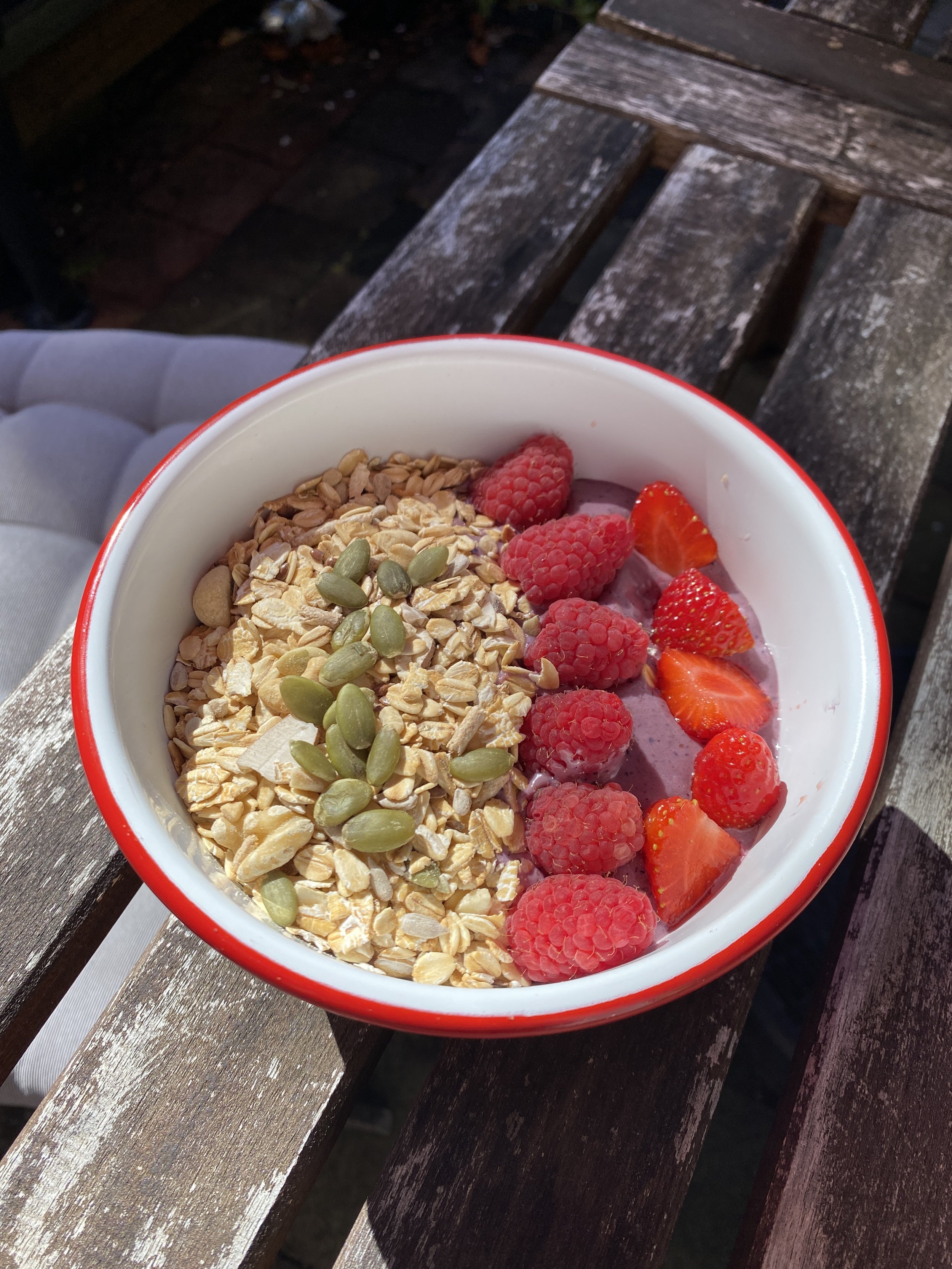
silken tofu summer breakfast bowl

This is the most heavenly breakfast on a baking hot summer’s morning, particularly if you’ve just been a for a run or walk and need both protein and to cool down!

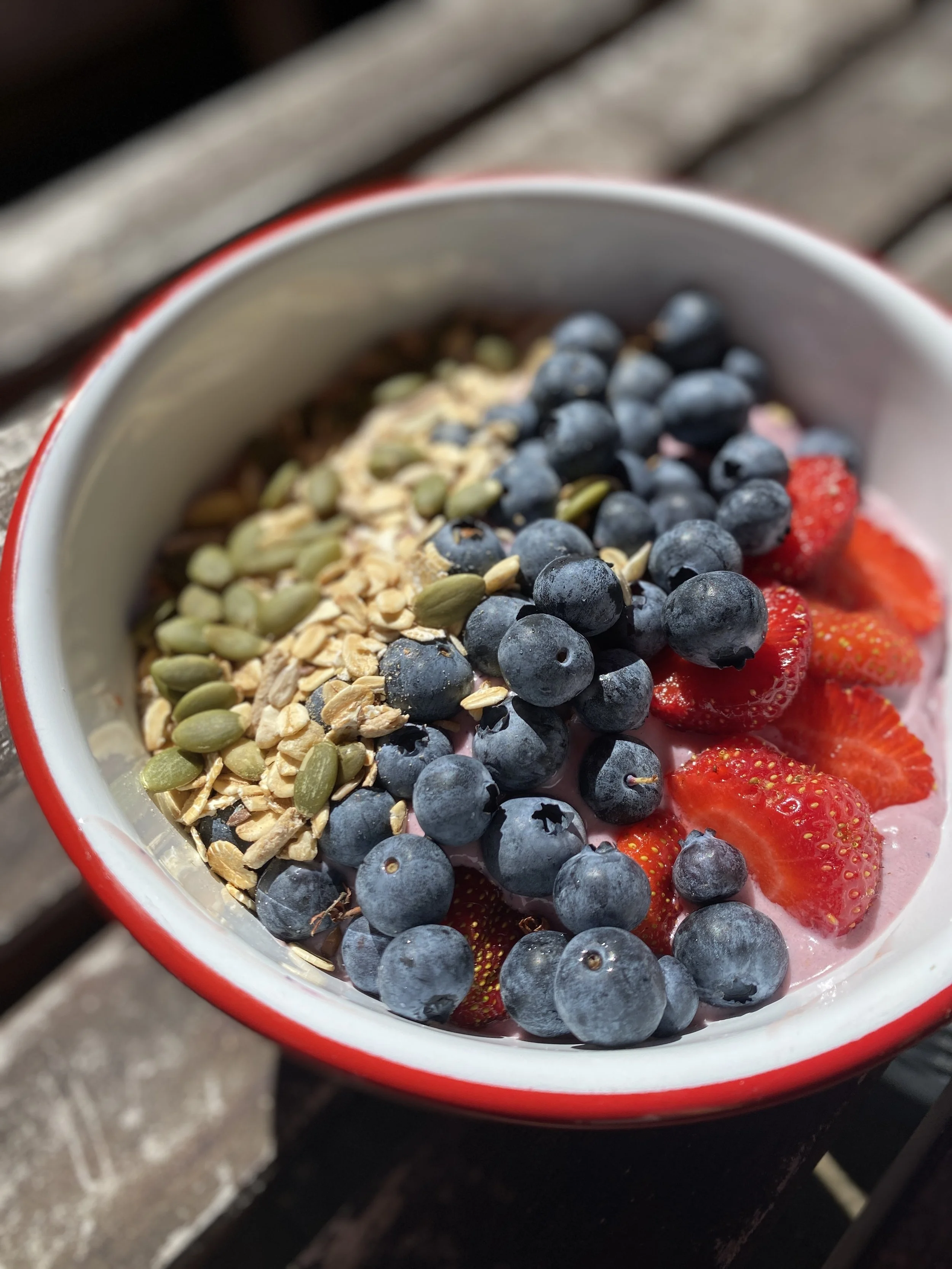
Silken tofu is the secret ingredient here, which results in a delicious and protein-rich alternative to yoghurt. You can load up your bowl with seasonal fruits and granola/muesli/seeds as you like. I tend to do a combination of both, as you can see.

The strawberries and blueberries are all homegrown, by the way!
Silken tofu summer breakfast bowls

Serves 2

1 x 300g pack of silken tofu (I tend to use Woolworths Macro brand)
150g frozen bananas
150g other frozen fruit (I most often use mango, blueberries and strawberries, but sometimes I’ve used apricots, pineapple and cherries. Alternatively just use 300g frozen bananas + handful of fresh fruit )
A handful of fresh fruit - optional - I usually put in a handful of fresh blueberries or strawberries from the garden that are fine to eat but a little wart-like in appearance
20g peanut or almond butter
Fresh seasonal fruit, to serve
Muesli, granola or nut/seed mix, to serve

It couldn’t be simpler - but you will need a powerful blender for this recipe, something that can basically crush ice. I’ve not tried it in my food processor but I can imagine it would produce similar results, you might just have to pause and scrape down the sides. My blender came with a special prodding stick, so you can “stir” the mixture as it blends, if anything gets stuck (and it usually does).

Open and carefully drain the excess liquid away from your silken tofu. Don’t worry if there’s still a little bit. Once you’ve done this you can either invert it on to a plate, or leave it in the container (which is what I do!), and use a small sharp knife to cut the tofu into rough cubes.

Place the silken tofu cubes in the blender first, and then add the rest of the ingredients. Adding the tofu first really helps the mixture blend better, as it turns to liquid that then draws all the other ingredients in!

If you have a digital scale, it’s even easier. I just place the empty blender jug on the scale, add the silken tofu, then reset the scale to zero and add the rest of the ingredients.

A note on the fruit: use whatever you’ve got and enjoy the combination of. It’s important that at least half the mixture is frozen fruit, as the more frozen fruit you use the thicker it will be (and I like it thick so I mostly use all frozen fruit with a bit of fresh as an extra). I only tend to buy frozen fruit when it’s on special, as it’s quite expensive these days. When bananas are in season and cheap, I buy several kilograms and freeze them. That way, I always have some frozen fruit on hand for a smoothie or for this breakfast bowl.

Place the lid on and blend until the ingredients become a thick smooth mixture, a bit like soft ice cream. If you have a prodding stick, like me, you can keep the blender running and prod the pesky bits from the sides (but be careful!). Otherwise, pause and scrape down the sides of the blender as needed. If it’s not blending, stop, and rearrange the ingredients, maybe add a touch of water or soy milk. As mentioned, adding the tofu first seems to avoid this.

Stop once everything is well combined and there are no remaining chunks of unblended frozen fruit. Keep an eye on it because if you like it thick, you’ll want to stop once everything is blended - the longer you blend, it will lose its thickness.

Once ready, pour (with the assistance of a spoon/spatula) into two waiting bowls (which you could also have chilling in the freezer, if it’s a particularly hot day).

Scatter the top with fresh seasonal fruit and muesli/granola/nuts/seeds. Eat!
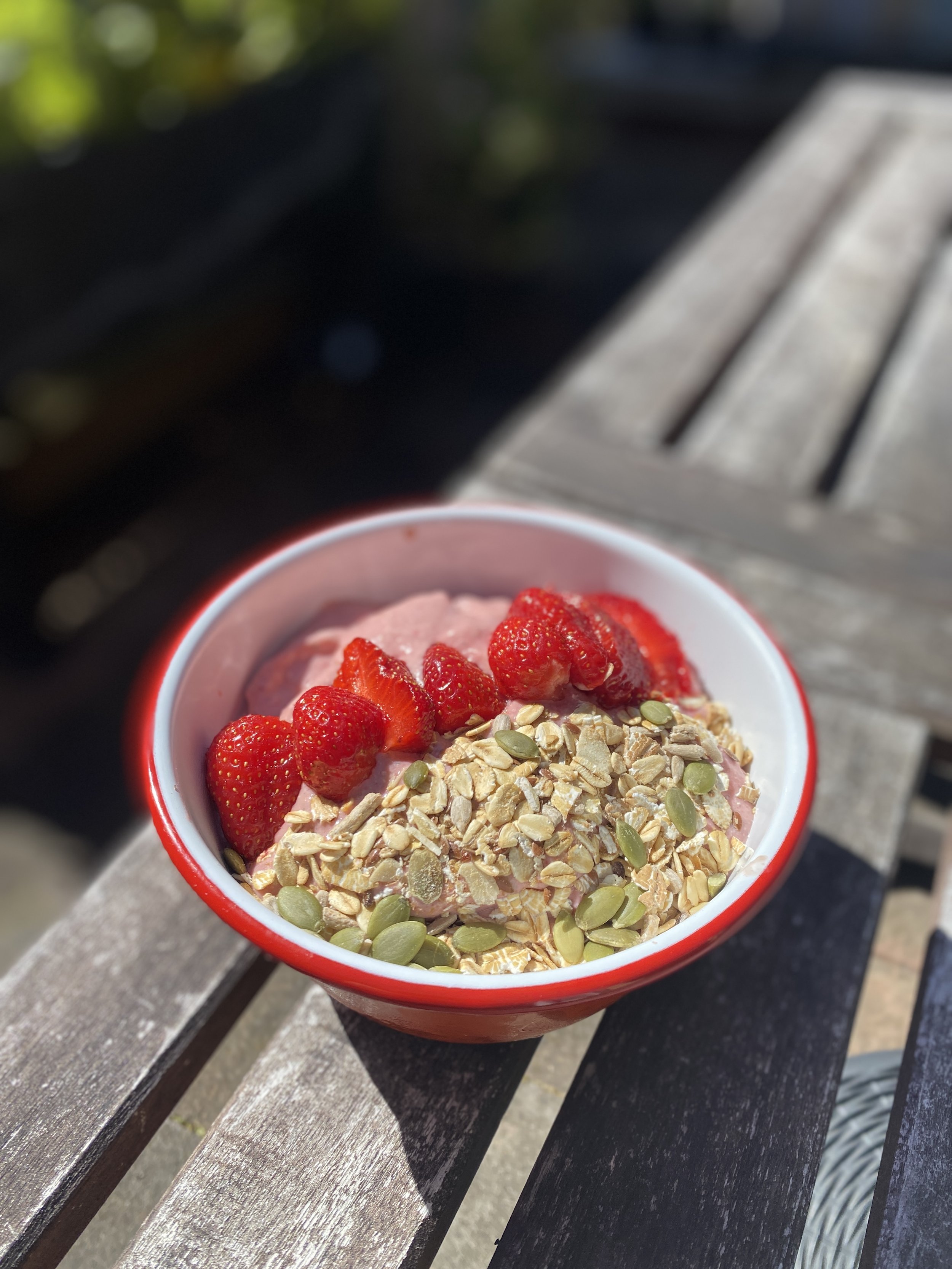
Best enjoyed sitting in your garden in the sun, soaking up the delicious headiness of summer. Memories of winter porridge will feel very distant indeed.

And I promise you, you can’t taste the tofu!
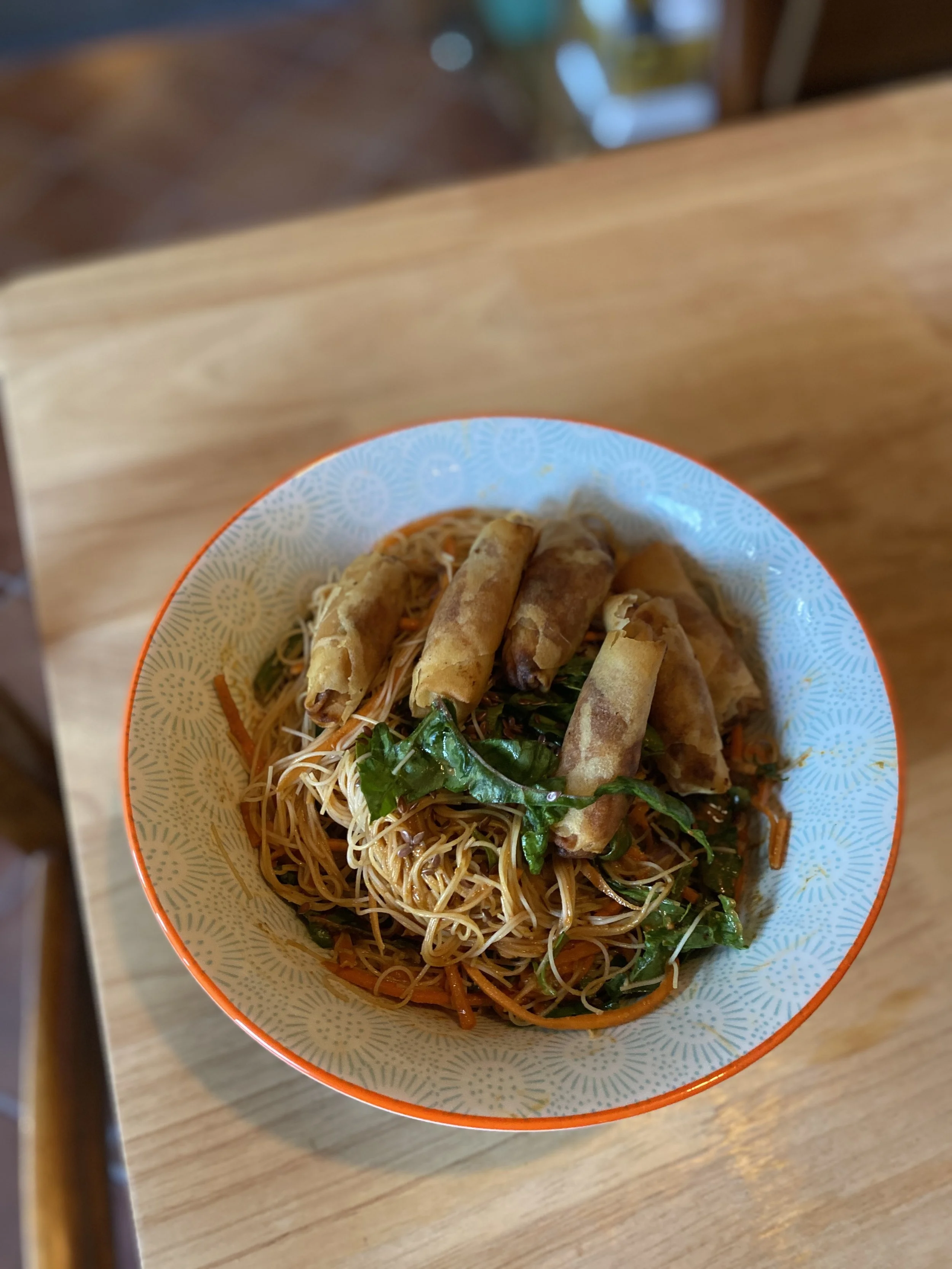
Bún Chả Giò Chay (Vietnamese rice noodle bowl with spring rolls)

This is one of my favourite summer meals. You know when you’re in the middle of a heatwave and the idea of turning on the stove makes you feel exhausted and even hotter, but you’re also wanting a fast, nourishing warm (ish) dinner? This ticks all the boxes.

I can’t claim this is an authentic Bún Chả Giò Chay as it very much changes every time I make it, depending on what vegetables I have in the fridge that need using, but it’s certainly delicious. Full of vegetables, refreshing, tangy and spicy. Absolutely perfect for those CBF-ed evenings and it’s also faster to put together than waiting for roughly the same thing from UberEats!

Bún Chả Giò Chay (Vietnamese rice noodle bowl with spring rolls)

Serves 2-4 (well, the two of us with leftovers for one)

200g dried rice vermicelli noodles (usually they are dried in individual nests so use 4 of those if so)
1 large or 2 medium carrots, julienned
Any other raw vegetables you have - I usually use cucumber cut into thin strips, red capsicum (pepper) cut into thin strips, whole or halved raw sugar snap peas or snow peas, julienned zucchini (courgette), and/or green beans - a small amount of each or a large amount of one will do!
1 cup cooked frozen green peas, baby green beans or edamame beans (optional)
A handful of spinach leaves, shredded
Vietnamese mint, as much as you like, roughly chopped (ordinary mint is fine but Vietnamese is wonderful if you can get it - I often use both as I love mint in savoury dishes)
Chives or the green part of spring onions, as much as you like, finely chopped
Any other soft green herbs such as coriander, Thai basil, etc that you might have, finely chopped
1 fresh red chilli, finely sliced (take out the seeds if you don’t want it too spicy)
12 mini frozen vegan spring rolls (in the UK I remember you could sometimes buy spring rolls in the chilled section of Sainsbury’s, ready cooked, so that’s even more of a time saver!)
Seeds (linseed, hemp or pumpkin), to sprinkle over to serve (optional)

3 heaped dessertspoons (roughly 60g) peanut butter or tahini (or see tip below)
2 tablespoons soy sauce or tamari, plus extra to serve
1 tablespoon maple or brown rice syrup
1½ tablespoons rice wine vinegar or lime juice (sometimes I use both)
Water to loosen
Extra lime juice to squeeze over
(it wouldn’t be the end of the world if you doubled the sauce ingredients and saved any leftovers in a clean jar in the fridge for a stir fry or to dip dumplings into later in the week, just saying)

Boil the kettle and put your spring rolls in the oven or air fryer to cook.

Place your rice vermicelli noodles in a large bowl. Pour boiling water over and leave to soak and soften. Perhaps set a timer for 5 minutes so you don’t forget!

While the noodles soak and the spring rolls cook, prepare the vegetables if you haven’t already. Assemble the vegetables, chopped chilli and herbs in large serving bowl.

Drain the noodles and rinse briefly under the cold tap. Shake well and leave to cool and drain thoroughly while you make the sauce.

For the sauce, I find the easiest thing is to put everything in an empty clean jar and shake vigorously to combine. As making jams and chutneys is a hobby of mine, I always have a jar hanging around!

In your jar (or bowl), place the first four sauce ingredients, and then determine if more liquid is needed - I usually pour in a little water from the kettle which, at this point, will still be hot but not boiling, which is good for loosening the peanut butter.

Speaking of which, I discovered this AMAZING peanut butter at the supermarket the other week and it is fantastic for a dish like this. It’s made in New Zealand and has wonderful smoky, spicy notes of paprika and chilli. Good news, looks like you can buy it wherever you are in the world! Highly recommended.

Put the lid of the jar on securely and shake, shake, shake until well combined. You might need to add some more water (or lime juice) so it’s not too thick. You want it the same consistency as a salad dressing. Err on the side of thinner rather than thicker.

Right, now it’s time to bring everything together. Get your drained noodles and add them to the bowl of vegetables, chilli and herbs. Pour over the sauce and then toss together with tongs or salad servers until well combined.

Prior to tossing!

The noodle salad can be left for five minutes or so until the spring rolls are ready. If your spring rolls are longer than that away, I would add the dressing when they are almost done.

Allow your spring rolls to cool slightly once they’re out of the oven or fryer, then cut each one in half (I forgot to do this in the one pictured - it’s much nicer when they’re cut in half rather than left whole, I think!)

Place a serving of noodle salad in a bowl and top with pieces of spring roll. You can sprinkle with some seeds or nuts for crunch, some extra fresh chilli or a drizzle of sriracha if you like it hot, or a squeeze of lime juice. You can also add more soy sauce, depending how salty you like it.

Enjoy outside as the sun goes down or in front of the TV with a cold beer! And be prepared to fight over who gets the leftovers for lunch the next day.

apricot and date chutney

apricot-and-date-chutney-philippa-moore

In February, my aunt very kindly gave me some apricots off her tree. When I say “some”, I mean 12 kilograms of them. Fortunately, Tasmanian apricots are incredible - like the sort of apricots you’d get in France - so I was not stumped on ideas of what to do with them. If anything, I had too many options!

I opted for stewing some, making jam, experimenting with mustard (which went terribly wrong, the jars exploded when we experienced summer’s last desperate attempt at heat) and turning the rest into delectable chutneys. Word has spread about these chutneys and they are now, after two months’ maturation in my pantry, a valuable currency to barter with in these strange times. I’ve swapped jars of it for fresh tomatoes, rhubarb, apples, cucumbers, pesto and even a new heater!

On chutney making day, apparently the whole street smelled of this delightful apricot and date concoction. Tom told me, as he turned the corner on to our street on his walk home from work, he followed the scent all the way back to our house! Chutney is a delightful thing for your home to smell of.

Be warned - this is not something you’ll be able to rustle up in a hurry. This is a labour of love and you will be exhausted by the end of it. It takes time, as all worthwhile things do, but you’ll be rewarded greatly for your efforts.

Apricot and date chutney

Makes heaps, at least 12 jars

3.5 kilograms fresh ripe apricots, halved and kernels discarded
900g brown sugar
900g pitted dates, halved (you could use sultanas if you prefer)
6 large onions, finely chopped
85g sea salt
1 litre vinegar (any kind - I used plain white vinegar from Woolworths!)
1 tablespoon ground cloves
2 tablespoons mustard powder or brown mustard seeds (I went with seeds for this batch)
2 tablespoons ground ginger
1 teaspoon cayenne pepper
2 teaspoons harissa powder or chilli powder (optional - I like everything to have a kick!)

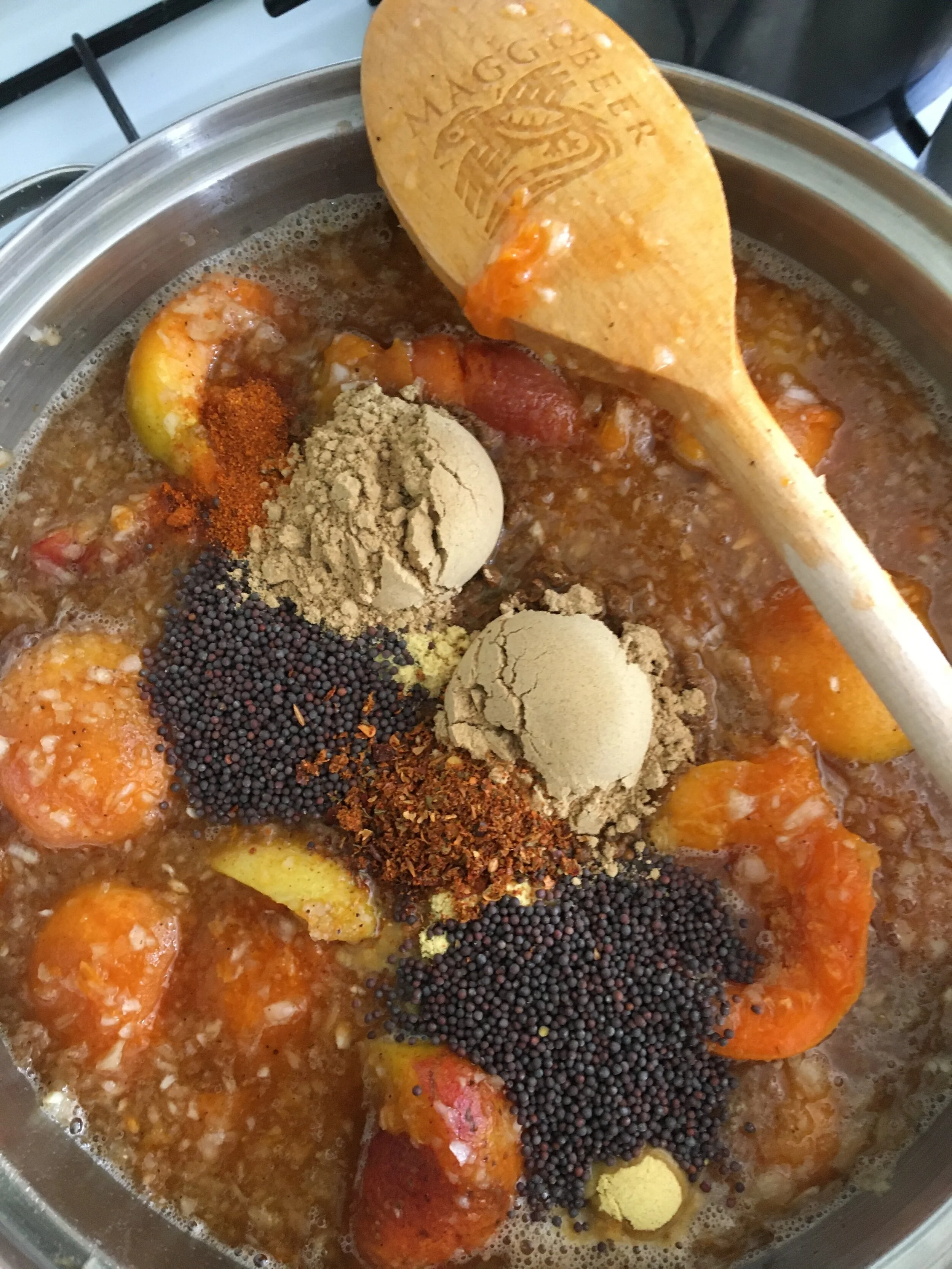
Place everything in a giant preserving pan (I inherited my grandmother’s) or a large stockpot. Bring to a slow boil, and then reduce to a simmer and cook until thick and the fruit has broken down. Thanks to the dates, it will be a rich brown colour.

In progress!

In progress!

The original recipe my aunt gave me said to cook for 45 minutes - I found I cooked mine for the best part of 3 hours until enough vinegar had evaporated and it was sufficiently thick. But my stove is a relic that belongs either in the tip or a museum, so you may well have a more modern and reliable stove that cooks the chutney faster! Either way, keep an eye on it, stir regularly to prevent it burning or sticking to the bottom, and go with your instincts. I’ve made a lot of chutney in my time, so I know when one is ready. It all comes with practice.

Have your jars sterilised and ready to go. I don’t have a dishwasher so I washed mine in hot soapy water then dried them in a low oven. This is quite intensive, but as I said at the start, this is not something you’ll do in half an hour, it’s very much a labour of love so you need to embrace the slow and enjoy the process.

Carefully pour the hot chutney into the hot jars. A funnel is ideal, if you have one big enough.

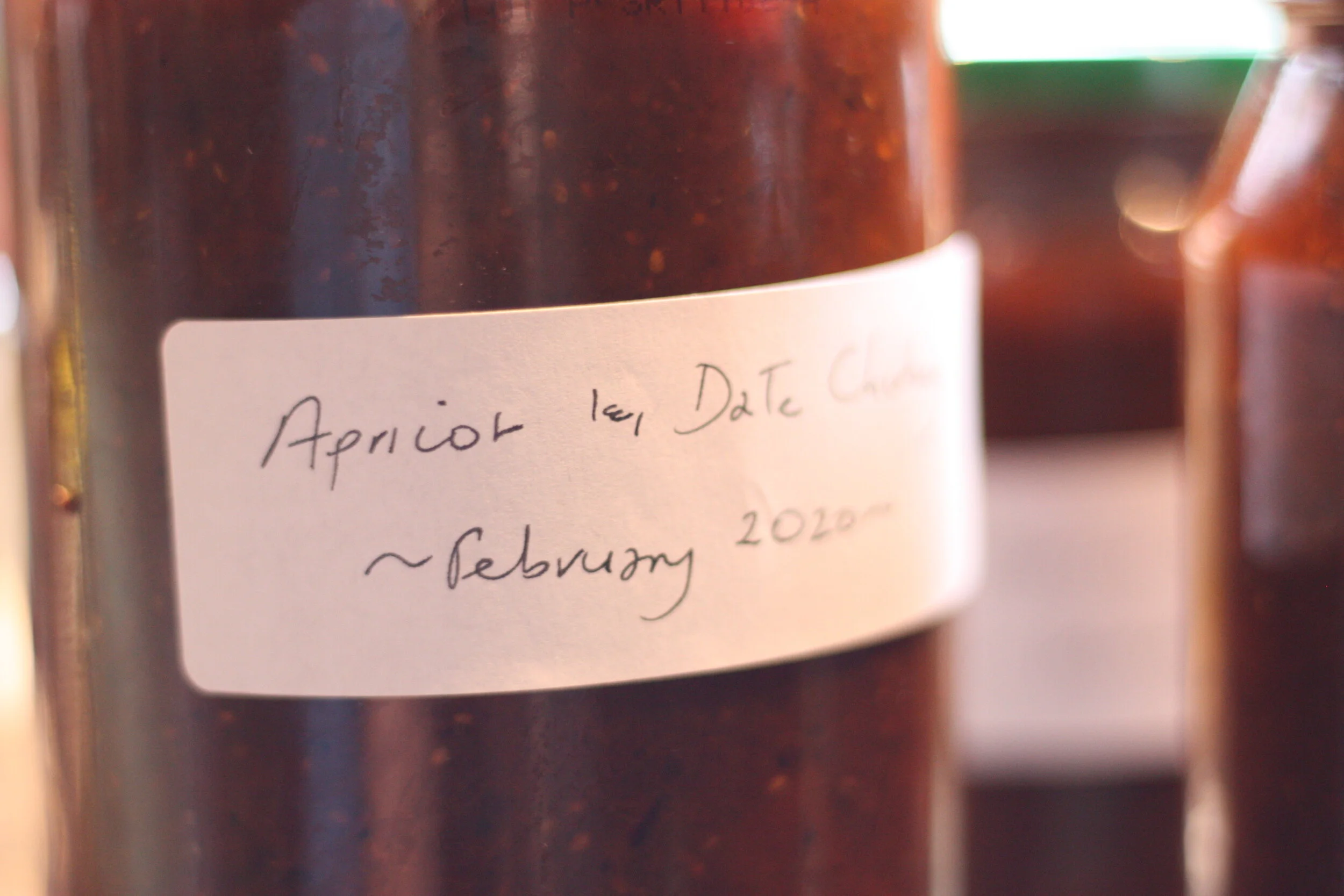
Seal immediately. Label when cool and then store the jars in a dark, cool place to mature. I opened the first jar after a month and it’s already excellent. The longer you leave it, the better it will be. You can keep them unopened in the pantry for up to a year, provided you’ve sterilised everything properly, but once you open a jar, keep it in the fridge.

This chutney has thousands of uses. I love it with cheese on toast, dolloped on dhal or another Indian curry, as an alternative to tomato ketchup for dipping chips in, with a veggie burger, or on the side of a giant wodge of zucchini slice.

when july was summer

Gin and tonics in our backyard last July.

Gin and tonics in our backyard last July.

Last July, it was summer, not winter.

Our one-way tickets to Australia were booked.

London wasn’t home any more. It’s a hard feeling to describe, when life is carrying on as much as it always has, but now there is no point buying plants for the garden, or that piece of furniture, for you know now there is an end date, and soon you will leave this corner of the earth. The house you live in and love will soon be someone else’s. You will disappear. It will be as if you had never been there at all.

Here is something I wrote at the time. Just some little observations. Things I wanted to remember.

Tom and I walking up to the street fair, July 2018

Tom and I walking up to the street fair, July 2018

8 July 2018

The third weekend in a row of high temperatures, the sun beating down, unfiltered by cloud. My shoulders tanned brown. Tom and I walk up to the village Green, where there’s a street fair. They’ve closed the road by the train station so the usually car-choked streets are filled with donkey rides, Enfield for Europe protestors, gin and tonic stands, a Mini convertible we know no one will win. The smells are intoxicating - Caribbean food, curries, kebabs, Vietnamese tofu grilled on hot coals, halloumi fries piled with pomegranate seeds.

enfield-for-europe-july-2018-philippa-moore

England are playing Sweden in the World Cup in a few hours so giant television screens are set up on the green, the air full of expectation. By the time we walk home with food for lunch, the streets will have emptied significantly. A few hours later, roars, screams and cheers will signal that England have triumphed. 

I linger at the plant stall, my favourite, full of varieties of sage and mint - apple, peppermint, pineapple. Heartsease, its purple flowers shaped like little hearts. House leeks, to ward off bad spirits. Thai basil, which I’m longing to cook with having been watching Rick Stein’s Far Eastern Odyssey. All the plants I would buy if we weren’t leaving. But it’s going to pain me to part with the ones I already have. I keep my coins in my purse and move on. 

plant-stall-london-philippa-moore

For weeks now we have lived on salads, veggie burgers, dips and raw vegetables, grains that can be cooked with water from the kettle. I can’t remember the last time I made pasta, soup or a curry. We have a little rain for the first time in nearly four weeks and my thirsty plants gulp it down.

The hard cantaloupe melon we bought yesterday, barely giving off a fragrance, is already ripe and begins to perfume the house. It is beginning to dip into a smell that is less perfume and more compost heap. I suspect we must eat it today.

melon-philippa-moore

The smell of over-ripe melon will always make think of that last summer in London.

PS: The reason for the photos with captions on them is because a few days later, on 13 July - bizarrely, coinciding with Trump’s visit to London - my phone died and I hadn’t backed up any photos since May. The only way I could access these pics was through Instagram stories!


summer couscous salad

couscous-salad

You know how you go through phases of not eating something for years - perhaps a decade - and have written it off in your mind as a bit boring, but then you rediscover it and think "why did I ever stop eating this?!" That is the story of me and couscous.

Twenty years ago, when I first tried couscous, I thought it was the best thing ever. My uncle made a lovely dish with it, lightly spiced, full of fresh herbs and studded with dried apricots. My favourite dish at a local trendy restaurant - Rockefellers, I think it was called - was their roast vegetable couscous salad. Every time I cooked it myself at home, I pretended I wasn't a bored 17-year-old living at home with three rowdy younger siblings, but some sophisticated trainee journalist in her Sydney or London apartment (clearly I thought trainee journalists living in such places were loaded). But like so many things, I had it so often that I got couscous fatigue. After a few disasters where it ended up clumpy and gross rather than fluffy and perfectly cooked, I threw in the towel and hadn't bought couscous since. 

I'm on a mission to clean out my pantry at the moment, dragging all the packets that were flung to the back when they were hopefully bought in 2014 or 2015 (eek) out to finally fulfil their culinary destiny. I found a packet of couscous, amongst the packets of kombu and nori when I was going through my making seitan from scratch phase, and felt a pang of nostalgia. Why not, I thought. 

It has also been uncharacteristically hot here this past week or so. For the first time in my 11 years here, London is experiencing a proper summer. Not just one or two hot days and then cloudy grey skies for the rest of the season, but full on 29 degrees every day for well over a week now. It's a miracle. I'm loving it. 

So any meal that involves not having to turn the oven or stove on is a winner during a heatwave. But there's only so many baby gems and packets of rocket and watercress you can eat. So this is where couscous is a GODSEND. All you have to do is boil a kettle. 

And after eating this salad, it's safe to say couscous won't be off my menu any time soon. Couscous and I are friends again and I couldn't be happier! 

It's seriously sensational. You can make this for a barbecue, as part of a mezze where you serve several salads, or just have it on its own. Cook the whole packet so you can pick at it all week during the heatwave.

Summer couscous salad

Serves 10 if served as a side, makes 5 generous portions if served alone

500g couscous
4 tablespoons olive oil (plus extra if needed)
800ml vegetable stock made with boiling water and stock powder

Rocket, as much as you have/want
Watercress, as much as you have/want
2 large pieces of roasted red pepper (out of a jar), chopped
Cherry tomatoes, as much as you have/want, halved
Sugar snap peas, as much as you have/want, halved
3 tablespoons capers
200g feta cheese, crumbled or cut into small cubes
1 fresh red chilli, finely chopped
1 small bunch flat leaf parsley, chopped
1 small bunch dill, chopped
Salt and pepper

Dressing:
3 tablespoons extra virgin olive oil
2 tablespoons white wine vinegar
2 tablespoons basil pesto

Place the couscous in a large bowl, preferably a clear glass one so you can see once all the liquid is absorbed. Add the oil to the top. Boil the kettle and make the stock. Pour the stock on top of the couscous and oil, stirring briefly to combine. Cover the top of the bowl with cling film and leave for 15 minutes, until the liquid is absorbed and the couscous is cooked.

While you're waiting, prepare the salad vegetables, feta and dressing. Put the dressing ingredients in a clean empty jar, put the lid on and then shake until well combined. Set aside.

Once the couscous is cooked, stir it well with a fork to make it all lovely and fluffy and break up any lumps. If it's too dry, add a little more olive oil. Once you're happy with it, turn it all out into a large, shallow serving bowl.

Add all the salad vegetables, capers, herbs, feta, chilli, salt and pepper and stir well to make sure everything is mixed well together. Finally, dress with the dressing and give it one final toss. 

It will sit happily if you have other parts of your meal that you're waiting on, otherwise dig in! It also keeps brilliantly and makes a great portable lunch for the office.

couscous-salad-2

Seriously, I will happily make and eat this every day for the rest of the summer if it means we can have more weather like this. Alleluia. It only took 11 years but thank you weather gods for giving London a proper summer at last!